Freshmark
← Back to all writing

Introduction to Basic Calculus: Elementary Integration

Starting from the mass integral, this article systematically introduces the concepts of indefinite and definite integrals, commonly used formulas and substitution methods, and demonstrates the practical application of integrals in competition physics through physical examples such as center of gravity calculation, n-dimensional sphere volume derivation, and resistance motion.

Introduction

If you know the density of each tiny part of a pig ρ\rho, how do you find the total mass?

M=Δmi=dm=ρ(r)dVM=\sum\Delta m_i=\int dm=\int\rho(\vec{r})dV

From this, the indefinite integral notation was introduced

Example 1

For a one-dimensional thin rod, its linear density per unit length ρ(x)=Ax4\rho(x)=Ax^4, find the total mass:

M=0l0ρ(x)dxM=\int_{0}^{l_0}\rho(x)dx

From this, the definite integral notation was introduced.

Among them:

IntegradeIntegral variableIntegral symbolUpper and lower limits
ρ(x)\rho(x)xx\intl0,0l_0,0

Operation

To find the indefinite integral, that is, to find the original function

Definition: If F(x)=f(x)F'(x)=f(x), then F(x)F(x) is called the original function of f(x)f(x).

It is easy to know that the original function is not unique and its constant term is arbitrary.

f(x)dx=F(x)+C\int f(x)dx=F(x)+C

Example 2

Through observation, find the indefinite integral of the following function.

(1) 5x3dx\int5x^3dx =54x4+C=\frac{5}{4}x^4+C (2) sin3xdx\int\sin3x dx =13cos3x+C=-\frac{1}{3}\cos3x+C (3) 4xdx\int\frac{4}{x}dx =4lnx+C=4\ln x+C (4) 7cos2xdx\int7\cos2xdx =72sin2x=\frac{7}{2}\sin 2x The following are commonly used indefinite integral tables:

\begin{gathered} % Common integrals for high-school physics competitions % ============ Basic integrals ============ \int x^n\,dx &= \frac{x^{n+1}}{n+1}+C, \quad n\neq -1 \\ \int \frac{1}{x}\,dx &= \ln|x|+C \\ \int e^{ax}\,dx &= \frac{1}{a}e^{ax}+C \\ \int a^{x}\,dx &= \frac{a^x}{\ln a}+C \\ \int \ln x\,dx &= x\ln x - x+C \\ % ============ Trigonometric functions ============ \int \sin x\,dx &= -\cos x+C \\ \int \cos x\,dx &= \sin x+C \\ \int \tan x\,dx &= -\ln|\cos x|+C \\ \int \sin^2 x\,dx &= \frac{x}{2}-\frac{\sin 2x}{4}+C \\ \int \cos^2 x\,dx &= \frac{x}{2}+\frac{\sin 2x}{4}+C \\ \int \sin(ax)\,dx &= -\frac{\cos(ax)}{a}+C \\ \int \cos(ax)\,dx &= \frac{\sin(ax)}{a}+C \\ % ============ Rational and radical forms ============ \int \frac{dx}{x^2+a^2} &= \frac{1}{a}\arctan\frac{x}{a}+C \\ \int \frac{dx}{x^2-a^2} &= \frac{1}{2a}\ln\left|\frac{x-a}{x+a}\right|+C \\ \int \frac{dx}{\sqrt{a^2-x^2}} &= \arcsin\frac{x}{a}+C \\ \int \frac{dx}{\sqrt{x^2\pm a^2}} &= \ln\left|x+\sqrt{x^2\pm a^2}\right|+C \\ \int \sqrt{a^2-x^2}\,dx &= \frac{x\sqrt{a^2-x^2}}{2}+\frac{a^2}{2}\arcsin\frac{x}{a}+C \\ % ============ Frequently used definite integrals ============ \int_0^\infty e^{-ax}\,dx &= \frac{1}{a} \\ \int_0^\infty x^n e^{-ax}\,dx &= \frac{n!}{a^{n+1}} \\ \int_{-\infty}^{+\infty} e^{-x^2}\,dx &= \sqrt{\pi} \\ \int_0^{\pi} \sin^2\theta\,d\theta = \int_0^{\pi}\cos^2\theta\,d\theta &= \frac{\pi}{2} \\ \int_0^{2\pi} \sin^2\theta\,d\theta = \int_0^{2\pi}\cos^2\theta\,d\theta &= \pi \\ % ============ Integration by parts ============ \int u\,dv &= uv - \int v\,du \\ \int x e^{ax}\,dx &= \frac{e^{ax}}{a}\left(x-\frac{1}{a}\right)+C \\ \int x\sin(ax)\,dx &= \frac{\sin(ax)}{a^2}-\frac{x\cos(ax)}{a}+C \\ \int x\cos(ax)\,dx &= \frac{\cos(ax)}{a^2}+\frac{x\sin(ax)}{a}+C \\ \int e^{ax}\sin(bx)\,dx &= \frac{e^{ax}(a\sin bx - b\cos bx)}{a^2+b^2}+C \\ \int e^{ax}\cos(bx)\,dx &= \frac{e^{ax}(a\cos bx + b\sin bx)}{a^2+b^2}+C \end{gathered}

Description

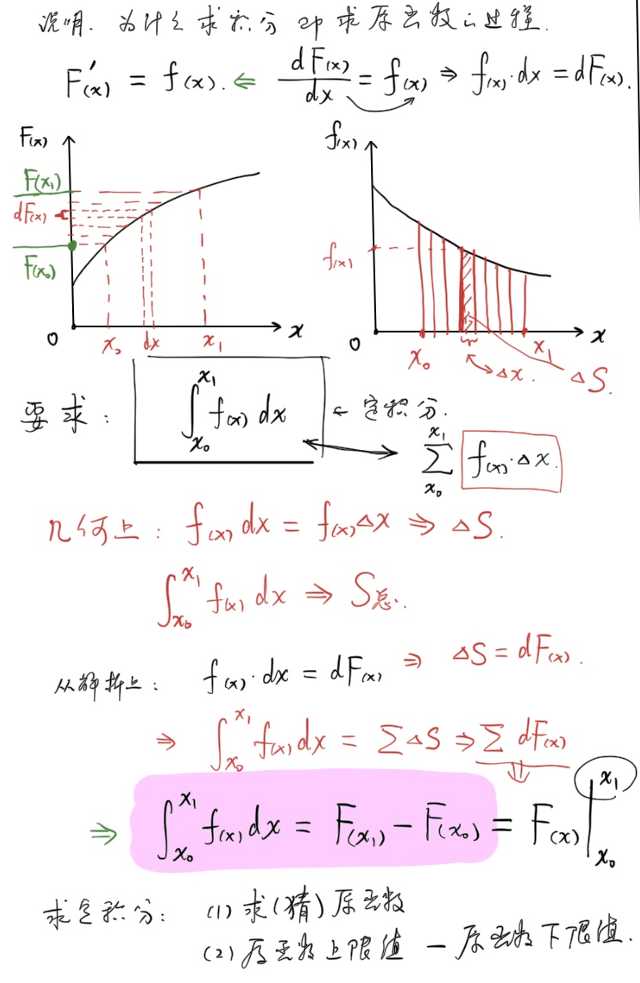
Why is finding the integral the process of finding the original function?

x0x1f(x)dx=x0x1f(x)dx=ΔS\int_{x_0}^{x_1} f(x)dx=\sum_{x_0}^{x_1}f(x)dx=\sum\Delta S

And dF(x)dx=f(x),\frac{dF(x)}{dx}=f(x), is dF(x)=f(x)dxdF(x)=f(x)dx, so:

x0x1f(x)dx=S=dF(x)=F(x1)F(x0)\int_{x_0}^{x_1} f(x)dx=S=\sum dF(x)=F(x_1)-F(x_0)

Noted as: x0x1f(x)dx=F(x)x0x1\int_{x_0}^{x_1} f(x)dx=\left.F(x\right)|_{x_0}^{x_1} It is not difficult to see that if the upper and lower limits of the definite integral are exchanged, the result becomes the opposite number.

alt text

Example 3

(1) 01(a+bx2)dx\int_{\textcolor{red}{0}}^{\textcolor{red}{-1}}(a+bx^2)dx

Original function F(x)=ax+b3x3+CF(x)=ax+\frac{b}{3}x^3+C 01(a+bx2)dx=F(1)F(0)=ab3\int_{0}^{-1}(a+bx^2)dx=F(-1)-F(0)=-a-\frac{b}{3} (2) absin(kt+ϕ0)dt\int_{a}^{b}\sin(kt+\phi_0)dt

Original function F(x)=1kcos(kt+ϕ0)+CF(x)=-\frac{1}{k}\cos(kt+\phi_0)+C absin(kt+ϕ0)dt=F(b)F(a)=...\int_{a}^{b}\sin(kt+\phi_0)dt=F(b)-F(a)=... (3) a2a1(x+a)2dx\int_{a}^{2a}\frac{1}{(x+a)^2}dx

Original function F(x)=(x+a)1+CF(x)=-(x+a)^{-1}+C a2a1(x+a)2dx=F(2a)F(a)=16a\int_{a}^{2a}\frac{1}{(x+a)^2}dx=F(2a)-F(a)=\frac{1}{6a} (4) 15dxx2+7x+12\int_{1}^{5}\frac{dx}{x^2+7x+12}

Write the integrand as a partial fraction: 1x2+7x+12=1x+3+1x+4\frac{1}{x^2+7x+12}=\frac{1}{x+3}+\frac{1}{x+4} Original function F(x)=ln(x+3)ln(x+4)+CF(x)=\ln(x+3)-\ln(x+4)+C 15dxx2+7x+12=F(5)F(1)=ln8ln9ln4+ln5=ln22ln3+ln5\int_{1}^{5}\frac{dx}{x^2+7x+12}=F(5)-F(1)=\ln8-\ln9-\ln4+\ln5=\ln2-2\ln3+\ln5 (5) 011x2dx\int_{0}^{1}\sqrt{1-x^2}dx

Use the second type of substitution method:

Let x=cosθ,θ[0,π2]x=\cos\theta,\theta\in [0,\frac{\pi}{2}]

Then 011x2dx=π20sinθd(cosθ)=π20sin2θ=π20cos2θ12\int_{0}^{1}\sqrt{1-x^2}dx=\int^{\textcolor{red}{0}}_{\textcolor{red}{\frac{\pi}{2}}}\sin\theta d(\cos\theta)=-\int_{\frac{\pi}{2}}^0\sin^2\theta=\int_{\frac{\pi}{2}}^0\frac{\cos2\theta-1}{2}

Original function F(x)=14sin2xx2+CF(x)=\frac{1}{4}\sin2x-\frac{x}{2}+C 011x2dx=F(0)F(π2)=π4\int_{0}^{1}\sqrt{1-x^2}dx=F(0)-F(\frac{\pi}{2})=\frac{\pi}{4} Substitution method: Replace x,dxx,dx and the upper and lower limits of the integral.

Example 4

alt text

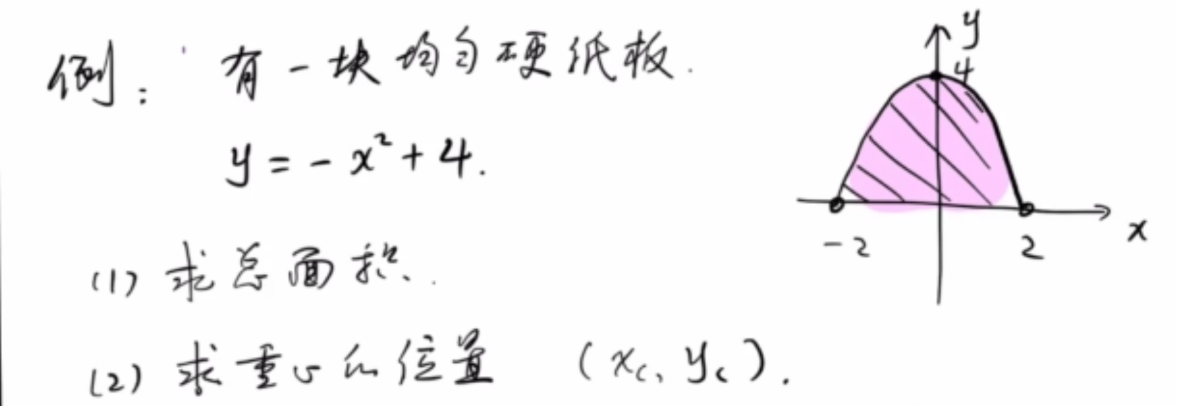
There is a piece of uniform cardboard whose shape is the figure enclosed by y=x2+4y=-x^2+4 and the x-axis

(1) Find the total area

(2) Find the area of the center of gravity (xc,yc)(x_c,y_c)

Note: In the integral formula, dxdx in f(x)dx\int f(x)dx naturally exists

(1) Cut vertically

dS=(4x2)dxS=dS=2+2(4x2)dx=(13x3+4x)2+2=323\begin{gathered} dS=(4-x^2)dx\\ S=\int dS=\int_{-2}^{+2}(4-x^2)dx=\left( -\frac{1}{3}x^3+4x \right)|_{-2}^{+2}=\frac{32}{3} \end{gathered}

(2) Cut horizontally

Since the figure is symmetrical, xc=0x_c=0 is defined by the center of gravity:

yc=ΣmiyiΣmiΣmiyiΣmi=ΣSiyiΣSi=0+42y4ydy323\begin{gathered} y_c=\frac{\Sigma{m_iy_i}}{\Sigma{m_i}}\\ \frac{\Sigma{m_iy_i}}{\Sigma{m_i}}\\ =\frac{\Sigma{S_iy_i}}{\Sigma{S_i}}\\ =\frac{\int_{0}^{+4}2y\sqrt{4-y}dy}{\frac{32}{3}} \end{gathered}

Method 1

The point is to calculate 04y4ydy\int_{0}^4y\sqrt{4-y}dy

Use trigonometric substitution to simplify algebraic relationships:

Let y=4sin2θ,θ[0,π2],dy=8sinθcosθdθy=4\sin^2\theta,\theta\in[0,\frac{\pi}{2}],dy=8\sin\theta\cos\theta d\theta

04y4ydy=640π2sin3θcos2θdθ=640π2sin2θcos2θdcosθ=6401(1u2)u2du=64(13u315u5)01=12815\begin{gathered} \int_{0}^4y\sqrt{4-y}dy\\ =64\int_{0}^{\frac{\pi}{2}}\sin^3\theta\cos^2\theta d\theta\\ =-64\int_{0}^{\frac{\pi}{2}}\sin^2\theta\cos^2\theta d\cos\theta\\ =64\int_{0}^{1}(1-u^2)u^2du\\ =64\left(\frac{1}{3}u^3-\frac{1}{5}u^5\right)|_{0}^{1}\\ =\frac{128}{15} \end{gathered}

yc=212815323=85y_c=\frac{2\frac{128}{15}}{\frac{32}{3}}=\frac{8}{5}

Method 2

yc=2xydySy_c=\frac{\int 2xydy}{S}

Since y=4x2,dy=2xdx,x[0,2]y=4-x^2,dy=-2xdx,x\in[0,2], therefore:

Note that integral substitution cannot change the range of the original variable, and the new variable should correspond one-to-one to the original variable.

yc=+204x2(4x2)dxS=(45x5163x3)+20S=85\begin{gathered} y_c=\frac{\int_{+2}^{0}4x^2(4-x^2)dx}{S}\\ =\frac{\left(\frac{4}{5}x^5-\frac{16}{3}x^3\right)|_{+2}^{0}}{S}\\ =\frac{8}{5} \end{gathered}

Example 5

Find the surface "area" and "volume" of an n-dimensional sphere

We define that the ball is the set of all points whose distance to point O is less than or equal to R.

It is not difficult to see that a one-dimensional ball is a line segment; a two-dimensional ball is a round cake; and a three-dimensional ball is a ball in the conventional sense.

Next, we define the areas and volumes of these spheres:

The volume of n-dimensional sphere VnV_n, that is, the ratio of occupied space to unit space

It is not difficult to derive from common sense: V1(R)=2R,V2(R)=πR2,V3(R)=43πR3V_1(R)=2R,V_2(R)=\pi R^2,V_3(R)=\frac{4}{3}\pi R^3 But when studying 4- and 5-dimensional balls, our common sense loses its effect.

To solve higher-dimensional problems, we resort to rethinking the lower-dimensional sphere:

From one-dimensional ball to two-dimensional ball

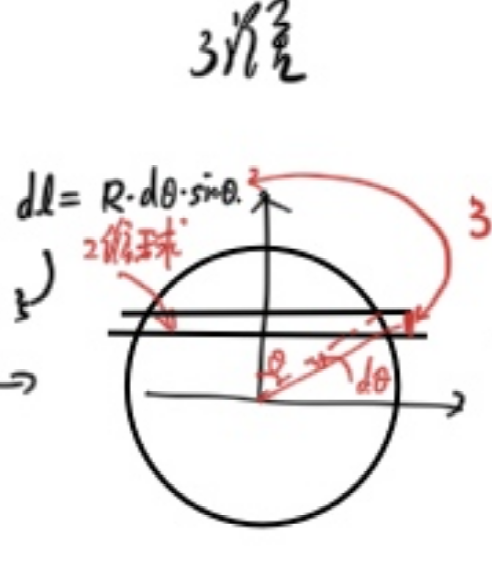
For a two-dimensional ball, cut each one at θ,θ+dθ\theta,\theta+d\theta

alt text

dV2=V1(Rsinθ)dl=2Rsinθ(Rsinθdθ)V2=dV2=0π2R2sin2θdθ=R20π(1cos2θ)dθ=R2(θ12sin2θ)0π=πR2\begin{gathered} dV_2=V_1(R\sin\theta)dl\\ =2R\sin\theta(R\sin\theta d\theta)\\ V_2=\int dV_2=\int_{0}^\pi 2R^2\sin^2\theta d\theta\\ =R^2\int_0^\pi (1-\cos2\theta)d\theta\\ =R^2\left(\theta-\frac{1}{2}\sin2\theta\right)|_0^\pi\\ =\pi R^2 \end{gathered}

From two-dimensional ball to three-dimensional ball

Continue to calculate the volume of the three-dimensional sphere:

Similarly, make a cut at θ,θ+dθ\theta,\theta+d\theta

dV3=V2(Rsinθ)dl=πR2sin2θ(Rsinθdθ)=πR3sin3θdθV3=dV3=0ππR3sin3θdθ=πR30π(1cos2θ)dcosθ=πR31+1(1u2)du=πR3(u13u3)11=43πR3\begin{gathered} dV_3=V_2(R\sin\theta)dl\\ =\pi R^2\sin^2\theta(R\sin\theta d\theta)\\ =\pi R^3\sin^3\theta d\theta\\ V_3=\int dV_3\\ =\int_{0}^\pi \pi R^3\sin^3\theta d\theta\\ =-\pi R^3\int_{0}^\pi (1-\cos^2\theta)d\cos\theta\\ =\pi R^3\int_{-1}^{+1}(1-u^2)du\\ =\pi R^3\left(u-\frac{1}{3}u^3\right)|_{-1}^{1}\\ =\frac{4}{3}\pi R^3 \end{gathered}

For trigonometric function integrals, there are the following secondary conclusions:

  • Odd powers: substitution
  • Even powers: double angle formula

From three-dimensional ball to four-dimensional ball

The exciting moment has arrived, following the previous solution:

dV4=V3(Rsinθ)(Rsinθdθ)=43πR4sin4θdθV4=dV4=43πR40πsin4θdθ=43πR40π(1cos2θ2)2=13πR40π(cos2θ2cosθ+1)dθ=13πR40π(12cos4θ2cos2θ+32)dθ=13πR4(18sin4θsin2θ+32θ)0π=12π2R4\begin{gathered} dV_4=V_3(R\sin\theta)(R\sin\theta d\theta)\\ =\frac{4}{3}\pi R^4\sin^4\theta d\theta\\ V_4=\int dV_4\\ =\frac{4}{3}\pi R^4\int_{0}^\pi \sin^4\theta d\theta\\ =\frac{4}{3}\pi R^4\int_{0}^\pi (\frac{1-\cos2\theta}{2})^2\\ =\frac{1}{3}\pi R^4\int_{0}^\pi (\cos^2\theta-2\cos\theta+1)d\theta\\ =\frac{1}{3}\pi R^4\int_{0}^\pi (\frac{1}{2}\cos4\theta-2\cos2\theta+\frac{3}{2})d\theta\\ =\frac{1}{3}\pi R^4\left(\frac{1}{8}\sin4\theta-\sin2\theta+\frac{3}{2}\theta\right)|_{0}^{\pi}\\ =\frac{1}{2}\pi^2 R^4 \end{gathered}

Example 6

alt text

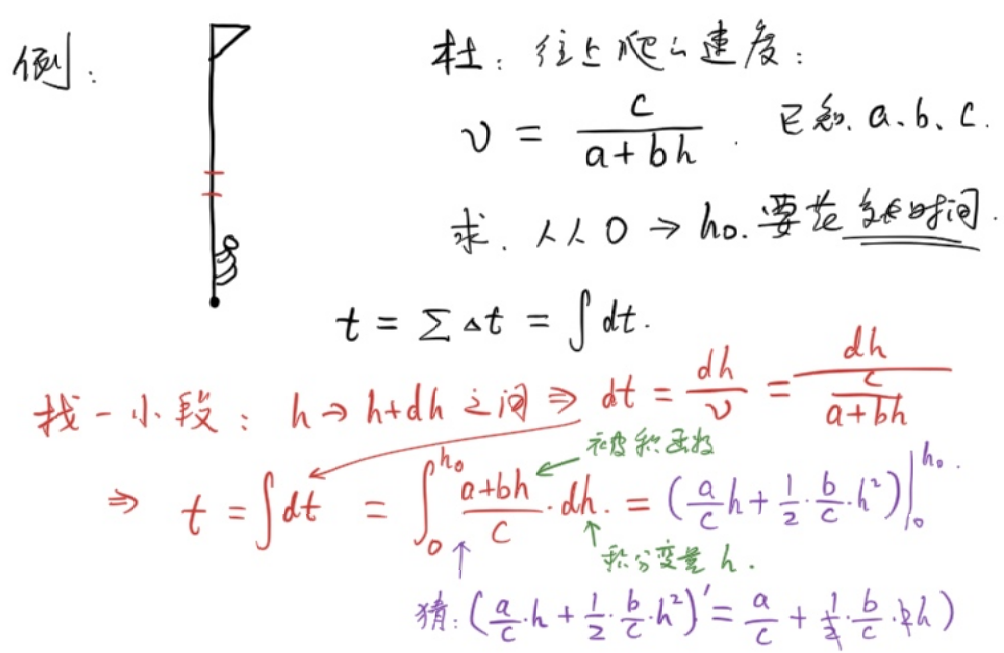
There is a person climbing up the flagpole. The upward speed is v=ca+bhv=\frac{c}{a+bh}, where a, b, and c are all constants.

Find the time it takes for this person to climb from height 0 to height h0h_0.

dt=dhv=dhca+bht=dt=0h0a+bhcdh=(ach+b2ch2)0h0=ach0+b2ch02\begin{gathered} dt=\frac{dh}{v}=\frac{dh}{\frac{c}{a+bh}}\\ t=\int dt\\ =\int_{0}^{h_0}\frac{a+bh}{c}dh\\ =\left(\frac{a}{c}h+\frac{b}{2c}h^2\right)|_0^{h_0}\\ =\frac{a}{c}h_0+\frac{b}{2c}h_0^2 \end{gathered}

Example 7

A horizontally moving ball has a mass of mm, an initial velocity of v0v_0, and a resistance force of f=kvf=-kv.

(1) Displacement of the ball when it stops xx

(2) Speed vv and displacement xx at any time tt

(1)

Newton's second law: a=fm=kmva=\frac{f}{m}=-\frac{k}{m}v

That is: dvdt=kmdxdt\frac{dv}{dt}=-\frac{k}{m}\frac{dx}{dt}

So dv=kmdxdv=-\frac{k}{m}dx dv=kmdx\boxed{dv=-\frac{k}{m}dx} (Aha) The first differential equation appears!

Since x and v correspond one to one, integrate both sides of the equation from start to stop:

v00dv=km0x0dxv0=kmx0x0=mv0k\begin{gathered} \int_{v_0}^0dv=-\frac{k}{m}\int_0^{x_0}dx\\ -v_0=-\frac{k}{m}x_0\\ x_0=\frac{mv_0}{k} \end{gathered}

(2) In the previous question, we eliminated dtdt and left dv,dxdv,dx.

In order to find v(t),x(t)v(t),x(t), dtdt cannot be eliminated

dvdt=kmvdt=mk1vdv0tdt=mkv0v1vdvt=mklnvv0v(t)=v0ektm\begin{gathered} \frac{dv}{dt}=-\frac{k}{m}v\\ dt=-\frac{m}{k}\frac{1}{v}dv\\ \int_{0}^tdt=-\frac{m}{k}\int_{v_0}^v\frac{1}{v}dv\\ t=-\frac{m}{k}\ln \frac{v}{v_0}\\ v(t)=v_0e^\frac{-kt}{m} \end{gathered}

x(t)=0tv(t)dt=v00tektmdt=v0(mkektm)0t=v0(mkektm+mk)=mv0k(1ektm)\begin{gathered} x(t)=\int_0^tv(t)dt\\ =v_0\int_0^te^\frac{-kt}{m}dt\\ =v_0\left(-\frac{m}{k}e^\frac{-kt}{m}\right)|_0^t\\ =v_0(-\frac{m}{k}e^{-\frac{kt}{m}}+\frac{m}{k}) \end{gathered}\\ =\frac{mv_0}{k}(1-e^{\frac{-kt}{m}})

Sonnet 4.6

Core Content

Starting from physical problems (such as finding mass and displacement), the article naturally introduces the concepts of indefinite integrals and definite integrals, and then demonstrates the actual operation methods of integrals through a large number of examples.

Main knowledge points

The article covers: the definition of indefinite integral (finding the original function) and definite integral; table of commonly used integral formulas; substitution method (trigonometric substitution, algebraic substitution) and integral by parts; and the geometric intuition of Newton-Leibniz formula.

Example question system

The example questions go from simple to deep, from basic polynomials and trigonometric function integration, and gradually transition to: calculation of the area and center of gravity of parabolic cardboard; recursive derivation of n-dimensional spherical volume (1 to 4 dimensions); physical applications (pole climbing problem, resistance motion problem), among which the resistance motion question naturally leads to the first differential equation.

Style Features

The writing is relaxed (the introduction of "a pig"), and both physical intuition and mathematical derivation are emphasized. It is suitable for students who have a certain foundation in high school mathematics and are preparing for physics competitions.